According to the American National Election Studies at the University of Michigan, the number of split-ticket voters in the electorate -- meaning people who vote for a Democrat for president and a Republican for Congress, or vice versa -- has gone up 42 percent since 1952. That shows a radical new willingness on the part of Americans to look at individual candidates, not party slates. It is a sign of a thinking electorate, not a partisan one.
I checked the NES. In 1952, 12 percent of voters split their ticket. In 2004, the number went up to about 17 percent--a 42 percent increase as Penn points out. But this obscures the fact that the vast majority of voters, 83 percent in the last election, still vote the party line. More importantly, this chart shows that the percentage of split ticket voters has been declining pretty steadily over the last 30 years. Penn could have just as easily and more accurately written that the percentage of split ticket voters has declined by 42 percent since 1972.
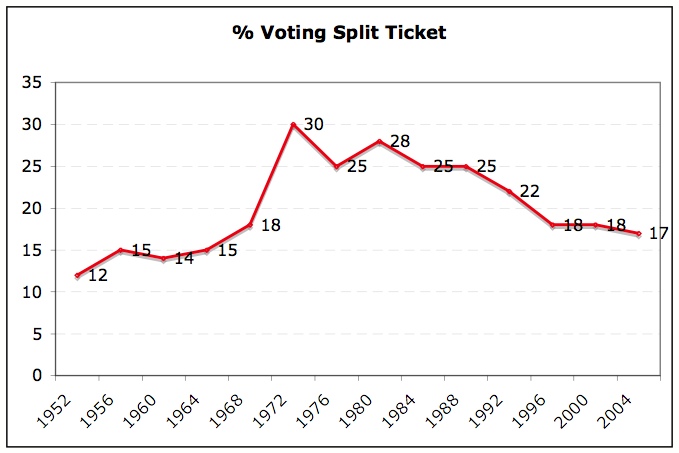
Penn was a consultant to Bill Clinton and has a reputation for trying to push the Democrats to the middle, hence his desire to show that split-ticket voters are an important constituency. That may or may not be good politics, but Penn doesn't help his argument by playing fast and loose with the numbers.
Update: Over at The Plank Michael Crowley points out that Penn is Hillary Clinton's pollster. Is his op-ed a way of under-cutting the argument that Hillary is becoming too centrist?


6 comments:
Fremont,
Remember, Ike had pretty good coattails. In 1952 the Republicans picked up 22 House seats. Also, the big source of Democratic House seats was still in the South, and they still voted pretty Democratic back then.
What seems to have happened is that in 1972 ticket splitting peaked as Nixon won in a landslide, but had no coattails and most Southern Democrats managed to hang on. Over time, that got harder and harder and people aligned their presidential and congressional votes.
He was a bigg spinner maybe the lying will stop
White House Chief of Staff Andy Card Resigns
people die and no one cares
Nine U.S. Troops Killed in Iraq; Three Missing
mORE INTERESTING NEWS FROM mAISON bLANCHE
Rove to Testify to Grand Jury in CIA Leak Case
This is pretty nuts
Immigration rally coverage from across the country
they had good coverage of this too
Post a Comment